
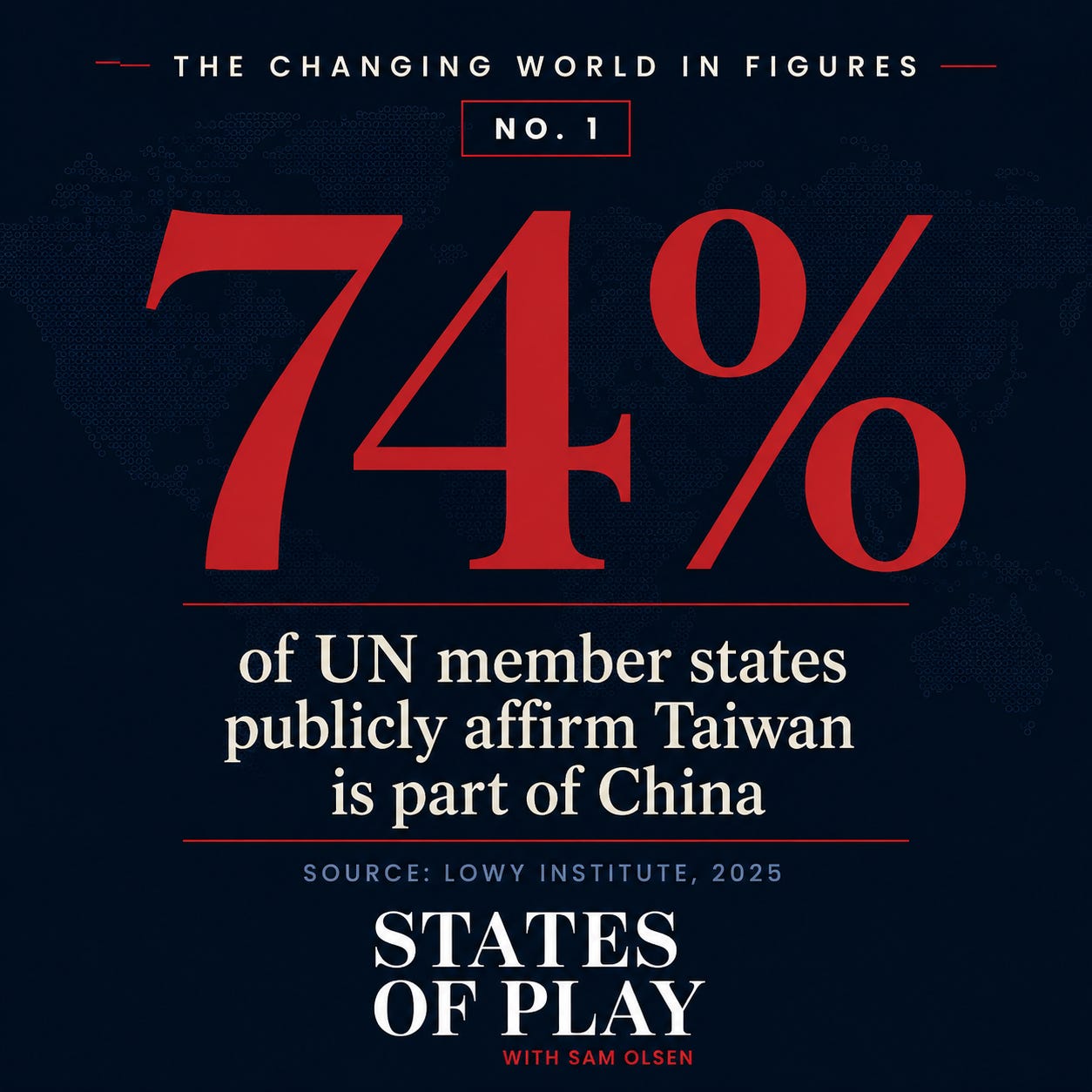
74%: The Changing World in Figures #1
As Trump and Xi meet, one statistic reveals how the world is increasingly split between the West and the Rest, the latter with China as their champion

Hello and welcome back to States of Play – the newsletter and podcast decoding the way the world is changing, from great-power rivalry to technological upheaval, defence strategies to demographic shifts.
Welcome to The Changing World in Figures, a new weekly series examining the changing world order through the statistics that reveal where power, influence and history are moving. Each edition takes one number and uses it to explain a larger global trend.
Many thanks for reading.
Sam
As Donald Trump and Xi Jinping prepare to meet this week, attention will naturally focus on tariffs, trade disputes, export controls and the increasingly dangerous question of Taiwan. Yet beneath the summit diplomacy and the familiar choreography of great-power rivalry lies a broader shift in the structure of the international system itself - one captured rather starkly by a single number.
74%.
According to a 2025 study by the Lowy Institute, 142 countries, representing roughly 74% of UN member states, now publicly affirm that Taiwan is part of China.
At one level, this may sound like little more than diplomatic wording. But in geopolitical terms it points towards something much larger: the extent to which much of the world has gradually moved closer to Beijing’s position on one of its most important strategic questions.
In Washington, the prevailing assumption often remains that the United States still holds the decisive advantages in the emerging contest with China. In many respects, that remains entirely true. America retains the world’s most powerful military, the dominant financial architecture, an extraordinary network of allies and technological strengths that continue to shape the global economy.
Yet power is not measured solely in aircraft carriers, sanctions regimes or semiconductor design. It is also reflected in political gravity - in which countries increasingly orient themselves around a rising power, accommodate its interests, or conclude that its influence will become too significant to ignore.
Viewed through that lens, the Taiwan figure becomes considerably more revealing.
Western political debate frequently frames Taiwan primarily as a struggle between democracy and authoritarianism, but much of the developing world does not necessarily see the issue in those terms. Across large parts of Asia, Africa, the Middle East and Latin America, governments tend to view Taiwan through a different set of calculations: sovereignty, non-interference, economic interest and long-term strategic pragmatism.
Nor is this occurring in isolation. Many of the same countries that now publicly support Beijing’s position on Taiwan also sit within the expanding network of the Belt and Road Initiative. Over the past two decades, China has embedded itself deeply into the infrastructure of the developing world through ports, railways, energy systems, telecommunications networks, mining projects and industrial supply chains. The Belt and Road Initiative is often described as an infrastructure programme, but in reality it functions as something much broader: an architecture of influence.
Trade relationships gradually become diplomatic relationships. Infrastructure finance creates political leverage. Industrial dependence shapes strategic behaviour over time.
The result is not a formal Chinese alliance system comparable to NATO, nor an ideologically coherent bloc in the Cold War sense. Most countries still seek to hedge between Washington and Beijing, hoping to maintain access to Chinese markets while preserving links to American security, Western finance and the broader global economy. But even within that hedging behaviour, a pattern is becoming increasingly visible.
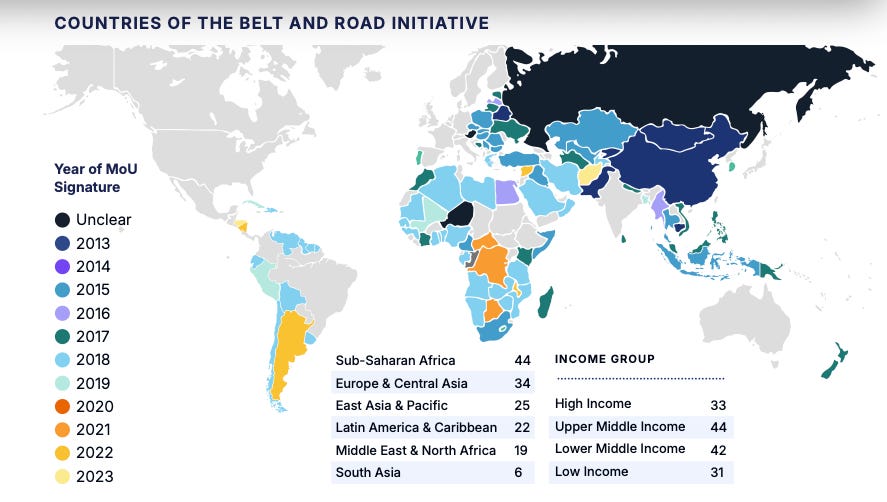
Much of the non-Western world is integrating more deeply with China, not necessarily because it seeks Chinese domination, but because Beijing has become central to the economic and political realities of the twenty-first century.
This is what makes the Trump–Xi meeting particularly significant. Trump is likely to enter the talks believing, with understandable confidence, that the United States still possesses the stronger military, technological and financial position. But China has spent years cultivating a different form of power - one rooted less in alliance structures than in connectivity, industrial centrality, infrastructure and economic dependence.
America still leads the West. China, meanwhile, is increasingly positioning itself as the indispensable power across much of the non-Western world.
That does not mean Beijing has already supplanted Washington as the world’s dominant power, nor that the international system is simply dividing into two opposing camps. The reality is more fluid, more fragmented and more transactional than that. Nevertheless, the direction of travel matters.
The significance of the 74% figure is not that China has already won the contest over Taiwan. It is that Beijing has succeeded in transforming economic scale into diplomatic weight across large parts of the international system. And as Trump and Xi sit down together this week, the more important question may not simply be which superpower appears stronger today, but which one more of the world increasingly believes will shape the future order tomorrow.