
A Simpler World for More Dangerous Times
The Iran war shows how our global system is no longer expanding, but retreating under stress

Hello and welcome back to States of Play – the newsletter and podcast decoding the way the world is changing, from great-power rivalry to technological upheaval, defence strategies to demographic shifts.
The war on Iran has been described by many as a significant turning point in history, and in many respects that judgment is justified. The scales have fallen from the eyes of many when it comes to the role the United States plays, given its great power willingness to act in pursuit of its own interests, even where those actions create wider geopolitical and geoeconomic instability. For some, the parallels with other recent conflicts are uncomfortable, reinforcing a sense that the rules of the international system are being bent, if not broken, by those once seen as their principal guardians.
But the Iran war is not only a story about power. It is also part of a broader structural shift already underway.
In today’s States of Play essay, the focus is not on the conflict itself, but on what it represents. Iran is another signal that the globalised system built over recent decades is under strain. If globalisation is, in essence, a story of increasing complexity, then what we are now witnessing is its certain reversal, a trend that began with the 2008 Greate Financial Crisis and then reinforced by the Covid pandemic, and is likely to shape the world for years to come. The question is, what comes after globalisation and complexity, and what does that mean for us?
Many thanks for reading.
Sam
A World Without Distance
If the war on Iran has taught us anything, it is how deeply interconnected the modern world has become, and how little distance now protects us from events far beyond our immediate horizon. A shock that begins in one region, however localised it may first appear, does not remain contained for long. It moves outward, carried along the arteries of global trade and finance, passing through shipping lanes and energy markets before finding its way into the price of food, the cost of fuel, and the political pressures felt far from the original event.
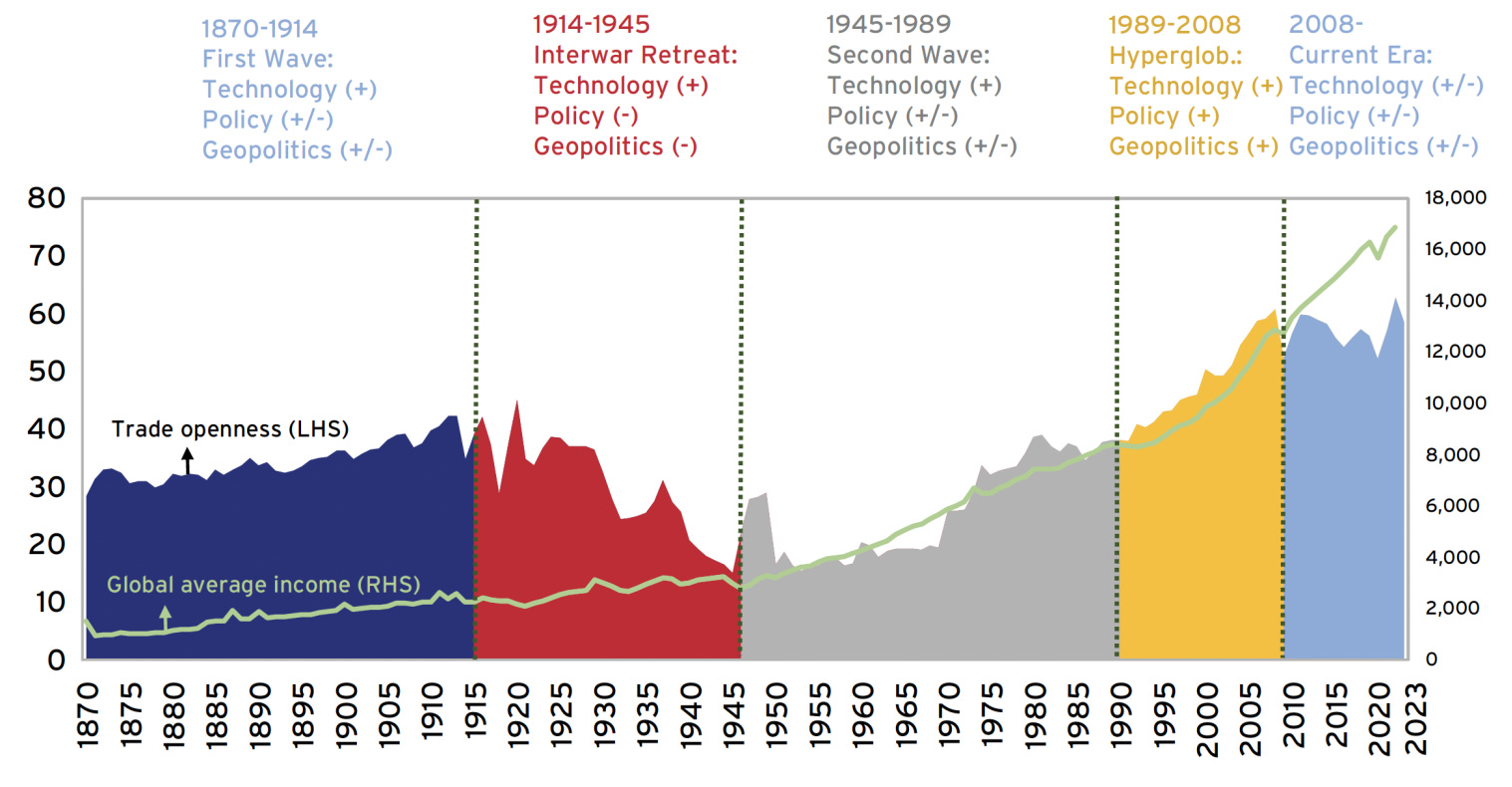
The effects are not limited to the obvious centres of power. They reach into the everyday lives of people far from the geopolitical fault lines, whether in London or Beijing, or in the towns of Argentina or the farms of the Philippines, where communities are now tied, often invisibly, into the same global systems of supply and demand. What unfolds in the Gulf can shape the conditions of life thousands of miles away, not because of proximity, but because of connection.
This is the defining feature of the world we have built over the past half-century: a system of extraordinary complexity, in which economies, technologies, and societies are bound together with a degree of interdependence that would have been difficult to imagine even a generation ago. Supply chains stretch across continents, financial markets move in real time, and energy systems link producers and consumers across vast distances.
The more complex the system became, the less able it was to absorb shock
Yet the same qualities that give the system its strength also shape how it responds to disruption. When shocks occur, they do not remain local. They travel along the same pathways that enable trade and cooperation, spreading effects far beyond their point of origin. What once appeared as resilience through integration increasingly reveals itself as exposure.
For much of the past half-century, this system expanded in scope and complexity, deepening connections and extending its reach into economic and social life. But the pressures now acting upon it suggest that this process may no longer be moving in the same direction.
The question is no longer how complex the world can become, but how much complexity it can sustain.
The Rise and Limits of Complexity
For much of human history, complexity has been a solution.
When societies encountered new challenges, they responded by becoming more organised and more sophisticated. They built systems to manage resources,
