
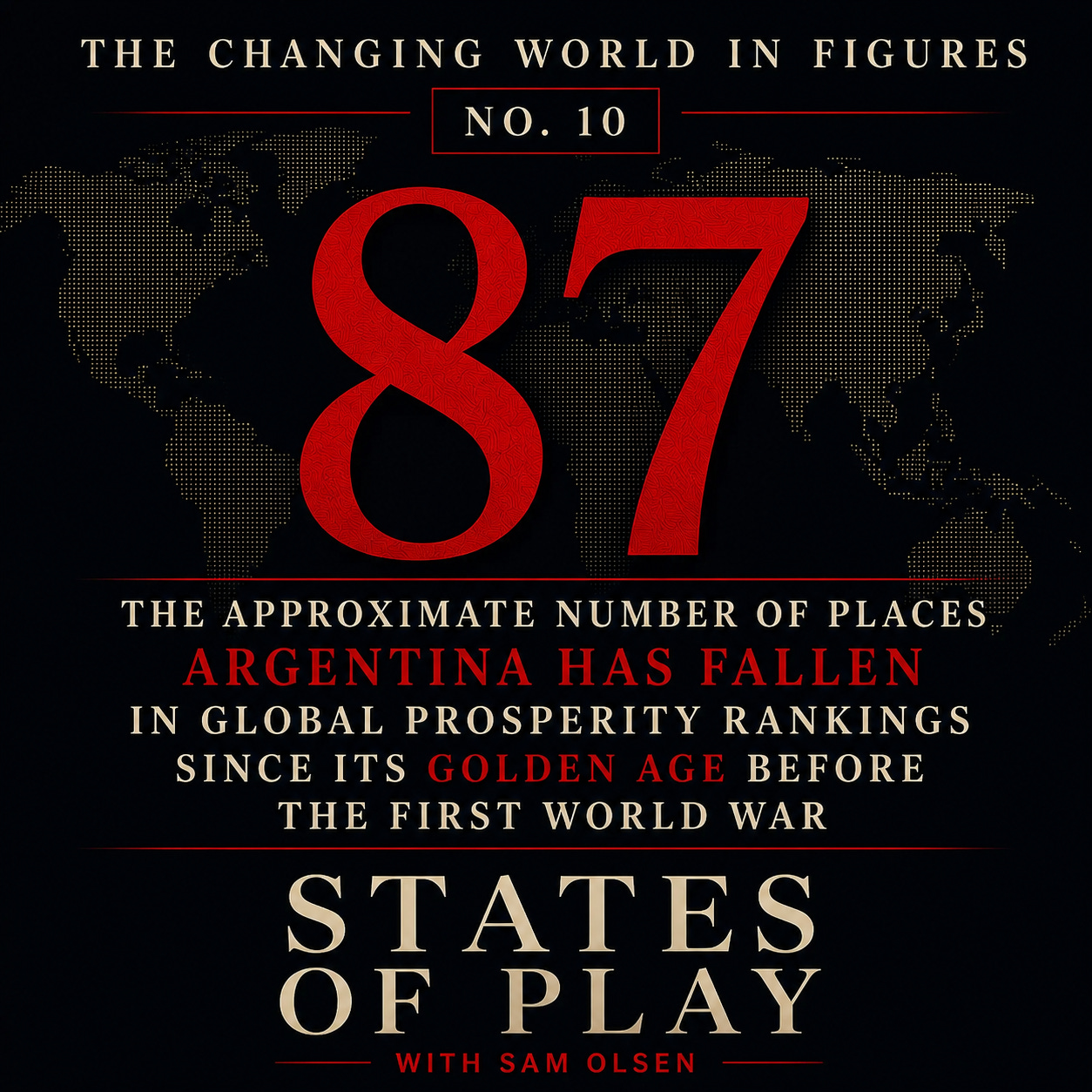
Changing World in Figures #10: 87
What Argentina's decline tells us about changing world orders

Hello and welcome back to States of Play, the newsletter exploring how the world is changing - from geopolitics to technology, from defence to demographics.
Following England’s (controversial for a Brit) World Cup semi-final defeat to Argentina, I thought this week’s Changing World in Figures should look at Argentina itself.
This week’s number is 87.
That is approximately the number of places Argentina has fallen in the world GDP per capita rankings since the eve of the First World War. According to the best historical estimates, Argentina ranked around ninth in the world in 1913. Today it sits around ninety-sixth.
How did one of history’s great economic success stories become one of its greatest cautionary tales?
On the eve of the First World War, Argentina looked unstoppable. Refrigerated ships laden with Argentine beef left the docks of Buenos Aires bound for the United Kingdom, while across the vast pampas British-financed railways carried cattle and grain to the coast. British capital built ports, banks and utilities, Britain became
Argentina became rich because it joined Britain’s world. It declined because it struggled to adapt when Britain’s world disappeared.
Argentina’s largest export market, and close commercial and social ties developed between Argentina’s landowning elite and Britain itself. Behind it all stood the Royal Navy, whose command of the seas helped secure the maritime trading routes upon which Argentina’s export-led economy depended. Buenos Aires became one of the world’s great cities, renowned for its grand boulevards, elegant architecture and extraordinary wealth. Within the British-led international order, few countries appeared better placed to flourish in the twentieth century.
Argentina’s success was no accident. Fertile land and abundant natural resources gave the country enormous potential, but geography alone rarely creates prosperity. Argentina transformed that potential into extraordinary wealth because it became deeply integrated into Britain’s markets, capital and security architecture during the first age of globalisation. Argentina became rich because it joined Britain’s world.
That illustrates a broader truth about world orders. One of the great misconceptions is that they are imposed solely through military power. In reality, the most successful
