
Is Mass Starvation Coming?
War-caused disruptions to fertiliser supply and a looming super El Niño are converging to create the conditions for a serious shock to global food production

Hello and welcome back to States of Play – the newsletter and podcast decoding the way the world is changing, from great-power rivalry to technological upheaval, defence strategies to demographic shifts.
A few days ago I appeared on the Daily Telegraph’s Battle Lines podcast to discuss the geopolitical consequences of the Iran war. Much of the conversation focused on familiar themes - escalation risks, the ability for the US to rearm, great power competition. But one issue stood out more starkly than the others: the potential impact on global food production. In particular, the disruption to fertiliser supply, and the extent to which modern agriculture depends upon it.
That concern has only sharpened in recent days, following warnings that a forthcoming El Niño could be among the strongest on record, with 2026 and 2027 likely to rank among the hottest years ever observed. Taken together, these developments raise a more fundamental question than the immediate trajectory of the conflict.
This essay examines the possibility that the current crisis could translate, over the coming year or so, into something far more consequential: a sustained shock to global food production, and with it the risk of widespread hunger.
Many thanks for reading.
Sam
The Fertiliser Shock and the Fragility of Global Food Supply
The ceasefire in the Gulf is beginning to fray. Although the conflict has not returned to full intensity, recent attacks by Iran on the UAE and related incidents have reintroduced uncertainty into a crisis that had slipped from the headlines. Over the past month, it was tempting to believe that the situation had stabilised and that a pause might open a path toward resolution.
That view now looks misplaced. Even if the ceasefire were to hold, the more important question lies elsewhere. Is there light at the end of the tunnel? On present trends, the answer appears to be no, not simply because the fighting may resume, but because the damage has already been done and will be felt not on the battlefield but in the food system.
Much of the analysis so far has focused on energy. Oil prices have risen and gas markets remain tight. There have also been concerns about industrial inputs such as helium and semiconductors. These issues matter, but they are not perhaps the most important story. The risk with the greatest human consequences lies elsewhere - in fertiliser.
Modern agriculture is far more dependent on fertiliser than is often recognised. Nitrogen, phosphate and potash are not peripheral inputs but central to sustaining yields, accounting for a substantial share of global crop production, in some estimates close to half. When supply is constrained, the adjustment is not immediate or visible. Farmers respond by reducing application rates, which allows crops to grow but with less strength and resilience.
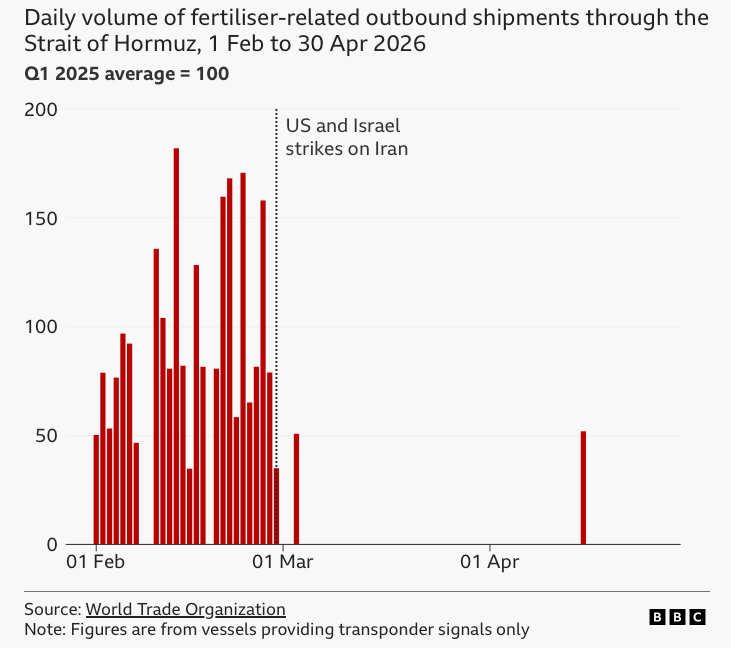
The result is a gradual decline in yields that becomes difficult to reverse once the growing season is underway. Despite this, fertiliser receives far less attention than oil, even though its importance is comparable. This makes the current disruption particularly significant, given that roughly a third of globally traded fertiliser passes through the Gulf.
Taken together, the fertiliser disruption caused by the Iran war, a strong El Niño, and the expectation that 2026 and 2027 will rank among the hottest years on record suggest a sustained shock to global food supply later this year, one that will reach far beyond the world’s poorest regions
Since the start of the Iran war fertiliser prices have risen sharply, with urea - the world’s most widely used nitrogen fertiliser, essential for boosting crop yields - at times increasing by more than 70 per cent year on year. One industry estimate suggests that current disruptions could equate to the loss of up to 10 billion meals globally over the course of a year. That figure should be treated with caution - it is not a forecast, but it does indicate the level of stress within the system. Small changes in inputs can produce large changes in output.
The risks are not theoretical. In 2021, Sri Lanka attempted a rapid shift away from synthetic fertilisers, and the consequences were felt almost immediately. Agricultural
