
The Trump–Xi Summit: Stabilisation, Symbolism, and Strategic Leverage
Warm words in Beijing masked a colder strategic question: who now holds the advantage?

Hello and welcome back to States of Play – the newsletter and podcast decoding the way the world is changing, from great-power rivalry to technological upheaval, defence strategies to demographic shifts.
In today’s essay, I examine the strategic meaning of the Xi–Trump summit in Beijing, and why the warm optics of diplomatic stabilisation may conceal a far harder geopolitical reality. Was this genuinely an attempt by both powers to restore calm after months of geopolitical and economic turbulence — or did it reveal something more unsettling about the changing balance of power between Washington and Beijing? Was this genuinely a stabilisation summit after months of geopolitical and economic turbulence, or did it reveal something more worrying (from a US point of view) about the changing balance of power between Washington and Beijing?
Did Trump arrive focused primarily on trade, business access, and economic stability, while Xi approached the summit testing American strategic resolve — particularly over Taiwan?
Is there now a growing shift in Washington towards a more economically driven China policy, with Trump increasingly centralising decision-making and traditional national security voices carrying less weight? If so, was that visible in Beijing?
Has America’s dependence on Chinese industrial supply chains — from rare earths to advanced manufacturing and critical technology — begun to constrain its strategic freedom of action?
Did the summit’s carefully choreographed symbolism also serve a deeper Chinese objective: reinforcing Beijing’s claim to strategic parity with the United States?
And if Chinese leaders leave Beijing believing the balance of leverage is shifting in their favour, what does that mean for Taiwan, America’s alliances in Asia, and the future of the wider international order?
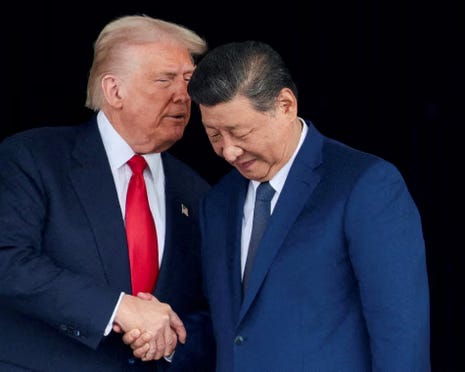
As ever, I look forward to hearing your thoughts on whether this was simply diplomatic theatre — or a genuinely important moment in the shifting balance between Washington and Beijing.
Many thanks for reading.
Sam
Summit Theatre and Strategic Signalling
Donald Trump emerged from two days of meetings with Xi Jinping in Beijing in strikingly expansive spirits. The talks, formal ceremonies, and carefully staged symbolism suggested a warming relationship between the world’s two most powerful states. Trump praised Xi as a “great leader”, described the discussions as “great”, and declared China “beautiful”.
At first glance, the imagery suggested a warming relationship between the world’s two most powerful states, and many will read the summit in precisely those terms: as an attempt by both Washington and Beijing to restore a measure of stability after a period of geopolitical and economic turbulence, much of it intensified by recent American actions in the Middle East.
There is some truth in that interpretation. Both powers have reasons to prefer calmer markets, steadier trade flows, and fewer immediate crises. But stabilisation is only part of the story, and perhaps not the most important part. The deeper significance of this summit lies not in the optics of cordiality, but in what they may reveal about the changing balance of power between Washington and Beijing. Trump’s warm reception may point to something more unsettling than diplomatic de-escalation: the possibility that American leverage over China is weaker than many in Washington still assume.
Beijing understands something Western policymakers have often underestimated: in diplomacy, theatre is not decorative. It is part of the negotiation itself.
The choice of venue, choreography, and tone were not incidental details assembled for the cameras. Xi was not merely hosting an American president; he was staging an encounter designed to communicate a political message to domestic and international audiences alike. China was presented not as an anxious authoritarian state or disruptive challenger, but as a civilisation of continuity, order, and historical confidence. Trump, by contrast, arrived as the leader of a country appearing to seek practical accommodation - trade stability, economic calm, and business access - while managing strategic uncertainty elsewhere.
Trump came to Beijing seeking economic calm. Xi appears to have arrived testing American strategic resolve
The contrast is revealing because it speaks to a deeper divergence in how the two sides appear to understand the relationship itself.
Trump’s arrival with more than thirty senior American business leaders, many from the technology sector, made the administration’s priorities unmistakably clear. The focus was economic: reducing trade friction, restoring supply-chain predictability, reassuring markets, and creating opportunities for American firms. Yet by the close of
