
What Makes a Great Power?
Brendan Simms on why Britain still belongs in the top tier, why France does not, and how the world’s leading powers may change

Hello and welcome back to States of Play, the newsletter exploring how the world is changing, from geopolitics to technology, defence to demographics.
I have spent much of the past year thinking and writing about power. What gives countries influence? Why do some shape the international order while others are forced to react to it? And as technology transforms the global economy, is the nature of power itself beginning to change?
Those questions sit at the heart of The Return of the Great Powers, the new book by acclaimed historian Brendan Simms, Professor of the History of European International Relations at the University of Cambridge and Director of its Centre for Geopolitics.
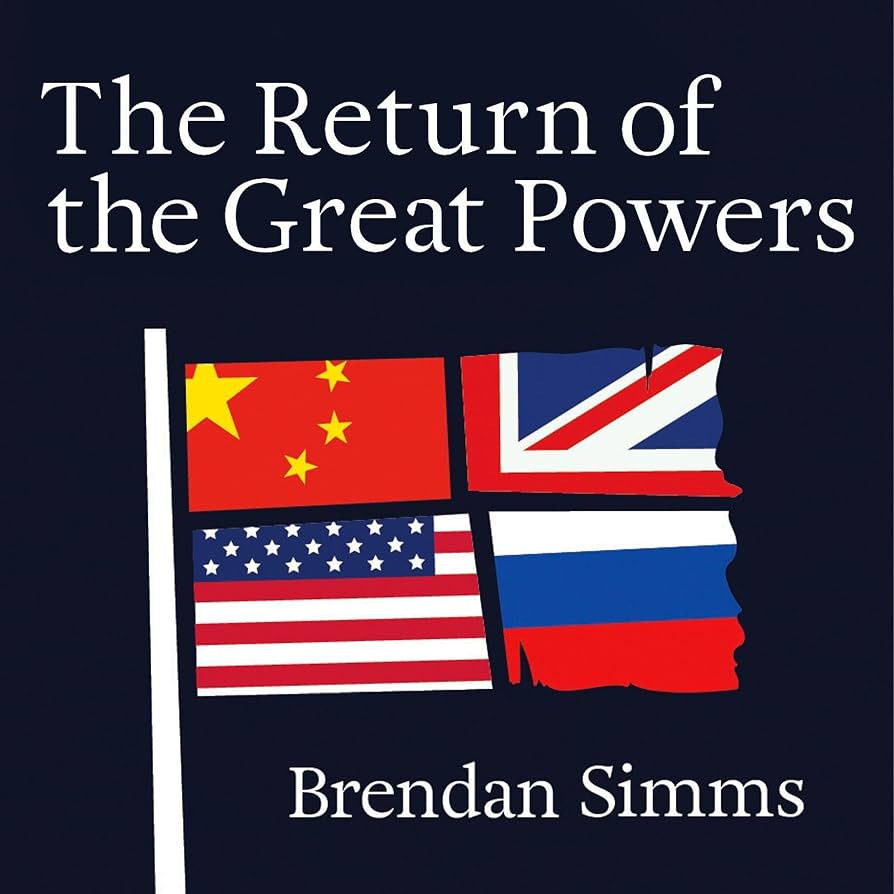
In his book, Brendan asks a series of questions that are becoming increasingly urgent as the international order changes. What makes a country a great power? Is it economic size, military strength, nuclear weapons or global reach? Or does great-power status rest on something more fundamental?
In today’s States of Play, I publish an edited version of a recent conversation with Brendan about the book and its arguments. Much of the discussion around The Return of the Great Powers has focused on his decision to include Britain among the four countries that still qualify. But for me, the more surprising argument concerns France, which Brendan believes no longer operates as a fully independent great power (there is a link to the EU in this). We also discuss why Germany and Japan fall short, whether China is changing the nature of power itself, and which countries might emerge as the great powers of the future.
For more of Brendan’s work, follow Brendan Simms on Substack.
Many thanks for reading. I’ll be back next Saturday with more insights into the changing world order.
Sam
What makes a Great Power?
Sam Olsen. Let’s begin with the most basic question. We constantly hear politicians and commentators talk about “great powers”, but very few people ever stop to define the term. What actually makes a country a great power?
Brendan Simms. For me, a great power is a state that consistently shapes the biggest questions in international politics. These are the countries that other states either have to consult or simply cannot ignore when major security issues arise. Whether we’re talking about the Napoleonic Wars, the two world wars, the Cold War or today’s conflicts in Ukraine and the Indo-Pacific, the same small group of countries repeatedly determines the outcome. That is the defining characteristic of a great power.
SO. Many people would instinctively point to economic size or diplomatic influence. Others would argue that soft power, the ability to attract and persuade rather than coerce, has become increasingly important in the twenty-first century. Is that enough?
BS. Soft power certainly matters, but it isn’t what ultimately defines a great power. Joseph Nye never argued that soft power replaced hard power; rather, it complemented it. During the relatively peaceful decades after the Cold War, it appeared more important because the major military rivalries of history seemed to have receded. But history suggests otherwise.
Take Britain before the First World War. It possessed overwhelming naval strength, but it also enjoyed considerable moral authority. Many governments preferred British leadership to German leadership, even where they disagreed with British policy. Soft power has always been part of the equation, but it has never removed the need for military capability or strategic reach.
SO. That strikes me as one of the central themes running through your book. Over the past thirty years we became accustomed to thinking that economics, globalisation and soft power had replaced traditional geopolitics. Your argument is almost the opposite: that security remains the organising principle of international politics, and that great powers are ultimately distinguished by their ability to shape that security environment.
BS. Just so. Economic strength matters because it underpins military capability, but it is not sufficient by itself. A country can be wealthy without being a great power. Equally, history contains examples of states whose economies were relatively modest but whose geopolitical influence was enormous. Great powers are those states that possess both the capability and the willingness to influence the international security order over time.
Which countries actually qualify?
SO. If that’s your definition, then the obvious follow-up question is: which countries actually qualify as great powers today?
BS. I would identify four: the United States, China, Russia and the United Kingdom.
Britain still possesses the global reach, strategic capability and political ambition that distinguish a great power
One point that’s important to make at the outset is that great powers are not, and never have been, equal in strength. The United States and China are obviously much more powerful overall than Britain and Russia. But that doesn’t disqualify the latter two.
History is full of examples of unequal great powers. In eighteenth-century Europe, for instance, Prussia was universally recognised as a great power despite being considerably weaker than France. The question isn’t whether countries possess identical levels of power. The question is whether they have the combination of resources, reach, reputation and resilience that allows them to shape international politics over time.
SO. That will surprise many readers, particularly the UK’s inclusion. Most people instinctively think of Britain as a country in relative decline. If asked to list today’s great powers, I suspect many would name the United States, China and perhaps Russia, before suggesting Germany or Japan ahead of Britain. Why do you think so many people have reached that conclusion?
